SF GATE. Posted on Thursday, March 27 at 7:01am | By David R. Baker If you’re a California resident who owns rooftop solar panels, you’ll want to pay close attention to a vote happening this morning in San Francisco. The California Public Utilities Commission is scheduled to vote on extending the rules that compensate solar homeowners and businesses for the excess electricity that they feed onto the grid. The system is called “net energy metering,” and it’s one of the main ways that California has encouraged the growth of the state’s solar industry. It’s also been the source of major friction between solar companies and California’s big electric utilities, who argue that net metering customers aren’t paying their fair share to maintain the grid. So a California law approved last year ordered the utilities commission to come up with a replacement system by the end of 2015. That same law also told the commission to create a transition period for people who already have rooftop arrays. After all, those people were counting on the compensation they’d receive from net metering when they decided to go solar. The compensation, which appears as a credit on utility bills, lets many homeowners slash their monthly utility payments close to zero.
See Original Article
Showing posts with label California CSI solar rebate. Show all posts
Showing posts with label California CSI solar rebate. Show all posts
Friday, March 28, 2014

Thursday, March 20, 2014
New Solar Hot Water Incentives for Low-Income Residences in California!
California Solar Initiative- CSI-Thermal Program Low-Income Program. Incentives are now available for Solar Water-Heating Systems for Low-Income Single and Multifamily Residences!
The CSI-Thermal Low-Income Program provides rebates to utility customers who install solar water heating (SWH) systems that displace natural gas usage. On October 6, 2011, the CPUC approved a Decision creating the CSI-Thermal Low-Income Program, which allocates $25 million to promote the installation of solar water heating (SWH) systems on qualifying low-income single-family and multifamily residences through a program of direct financial incentives. Incentives are available to customers who currently heat their water with natural gas in the service territories of Pacific Gas and Electric Company (PG&E), San Diego Gas & Electric (SDG&E), and Southern California Gas Company (SoCalGas).
Single-family SWH systems that displace natural gas can qualify for incentives up to $3,750. Multifamily applicants can qualify for incentives up to $500,000. Actual incentive amounts will be based on the expected performance of the system as predicted by the SRCC rating and positioning, as is current practice in the CSI-Thermal General Market program. Single-family low-income SWH systems will be determined using the existing CSI-Thermal single-family calculator, and multifamily low-income SWH system will use the CSI-Thermal multifamily calculator. Incentive levels will decline in four steps as the program meets certain installation benchmarks.
See original article
Tuesday, March 18, 2014
L.A. Can Lead the Way with Solar Rooftops
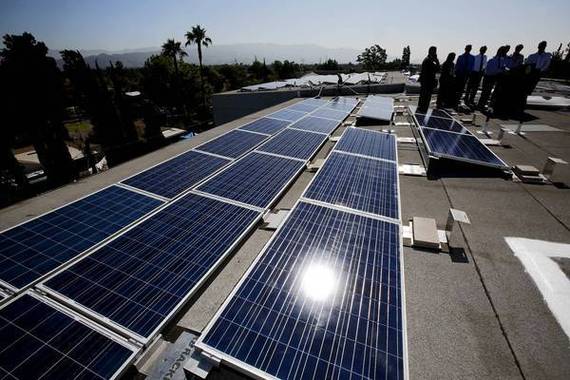
In contrast to the public's dismay with oil drilling, an overwhelming majority of L.A. voters have steadfastly demanded that local solar power more of their city. City council members -- as well as a broad coalition of business, civic, academic and environmental groups -- have echoed the public's call. To address this demand the DWP launched its CLEAN L.A. Solar program last year. Through this program, the utility pays customers for solar energy generated on rooftops throughout the city. CLEAN L.A Solar is on pace to bring 150 megawatts of local solar online by 2016 -- enough to power more than 32,000 homes. In addition to significantly reducing carbon emissions, CLEAN L.A. Solar also translates demand for clean energy into local economic growth. The program will create 4,500 jobs and generate $500 million in economic activity according to the Los Angeles Business Council.
See original article
Friday, March 14, 2014
County approves McCoy Solar Energy Project in the Palo Verde Valley
PALO VERDE VALLEY TIMES. 3.14.14 RIVERSIDE COUNTY, Calif. - The Riverside County Board of Supervisors today unanimously approved permits and a development agreement for the McCoy Solar Energy Project, which will create jobs in the Palo Verde Valley, revenue for Riverside County and renewable energy to the power grid. The project is the first to finish the permitting process since the county's solar power plant policy was enacted, outlining the terms of payments to the county for the use of its property and for committing vast tracts of land exclusively to solar development. The policy requires developers of solar projects greater than 20 megawatts to make payments to the county of $150 per-acre, adjusted annually to inflation, through a negotiated agreement between the county and the solar developer.
Supervisor John J. Benoit credits the board-approved policy with paving the way for a successful approval of the McCoy Solar Energy Project and its related development agreement. The project developer, McCoy Solar, LLC a subsidiary of NextEra Energy Resources, Inc., knew what it would be expected to pay under the terms of the agreement which will grant a right to develop the property as a solar project for the next 30 years. "Today is a historic vote, the result of amicable and smooth negotiations with NextEra and agreement on all issues and concerns," said Supervisor John J. Benoit. "This project will put hundreds of people to work and we can look forward to long-term benefits to the county."
The project is scheduled to be built in phases. The first phase of 2,262 acres could bring Riverside County as much as $14 million over 30 years and would ensure the project's sales and use taxes are allocated to the county. Depending on when the second phase is built, this amount could increase substantially. The agreed-upon total solar power plant net acreage is 4,442 acres at full build-out.
See original article
Thursday, March 6, 2014
Why the U.S. Power Grid's Days Are Numbered
BLOOMBERG BUSINESS.
There are 3,200 utilities that make up the U.S. electrical
grid, the largest machine in the world. These power companies sell $400
billion worth of electricity a year, mostly derived from burning fossil
fuels in centralized stations and distributed over 2.7 million miles of
power lines. Regulators set rates; utilities get guaranteed returns;
investors get sure-thing dividends. It’s a model that hasn’t changed
much since Thomas Edison invented the light bulb. And it’s doomed to
obsolescence. That’s the opinion of David Crane, chief executive
officer of NRG Energy, a wholesale power company based in Princeton,
N.J. What’s afoot is a confluence of green energy and computer
technology, deregulation, cheap natural gas, and political pressure
that, as Crane starkly frames it, poses “a mortal threat to the existing
utility system.” He says that in about the time it has taken cell
phones to supplant land lines in most U.S. homes, the grid will become
increasingly irrelevant as customers move toward decentralized homegrown
green energy. Rooftop solar, in particular, is turning tens of
thousands of businesses and households into power producers. Such
distributed generation, to use the industry’s term for power produced
outside the grid, is certain to grow.
Crane, 54, a Harvard-educated father of five, drives himself to work every day in his electric Tesla Model S. He gave his college-age son an electric Nissan Leaf. He worries about the impact of warming on the earth his grandchildren will inherit. And he seems to relish his role as utility industry gadfly, framing its future in Cassandra-like terms. As Crane sees it, some utilities will get trapped in an economic death spiral as distributed generation eats into their regulated revenue stream and forces them to raise rates, thereby driving more customers off the grid. Some customers, particularly in the sunny West and high-cost Northeast, already realize that “they don’t need the power industry at all,” Crane says.
See original article
Friday, February 28, 2014
Solar Industry Jump-Starts a Revival in California
NEW YORK TIMES. OAKLAND,
Calif. — Back in 2009, when Danny Kennedy was looking for office space
for the fast-growing solar services company he had co-founded, his
venture capital investors recommended setting up shop in one of the
“Twitterville kinds of areas” south of Market Street in San Francisco. There,
social media and peer-to-peer pioneers like Foursquare, Yelp, Airbnb
and, indeed, Twitter had created a technology zone where innovative
ideas could fly free and cross-pollinate among young workers meeting
casually over food and drink. Instead
— after looking at buildings he deemed “foggy and frumpy and cold and
wet,” not to mention expensive — Mr. Kennedy ended up in an airy loft
across the bay here at Jack London Square. In just four years, the company, Sungevity,
has grown to 300 employees from 55 in its 11,000-square-foot space
overlooking the Oakland Estuary, helping jump-start the area’s stalled
revitalization. Taking things a step further, Mr. Kennedy, a former environmental advocate, has developed an incubator-accelerator program, the SfunCube, to attract and nurture other solar start-ups. “The
whole point of the SfunCube is to bring in a whole bunch of solar
companies, populate the whole square with a bunch of solar professionals
and turn it into, like, a solar campus,” he said. “If
we succeed in our task,” he added, “we’ll have thousands of solar
industry workers here — they’ll want to walk to work or cycle. They’ll
become the population that helps make that happen. The whole thing will
be this nice, synergistic sort of lift-all-boats kind of deal.”
Thursday, February 20, 2014
Solar Investing Grows Up
When I was asked in an interview last month what I thought 2014 would hold for green tech finance, I said 2014 would be the year that “renewable energy finance comes of age.” What I mean is that a new type of renewable energy investment is proliferating. Solar, other renewables, and energy efficiency investments are no longer limited to risky growth plays like Tesla Motors (NASD:TSLA.) There are now a number of yield focused investments available to small investors. As of last year, there was a mostly hydropower partnership: Brookfield Renewable Energy Partners (NYSE:BEP), an energy efficiency focused Real Estate Investment Trust (REIT): Hannon Armstrong Sustainable Infrastructure (NYSE:HASI), and a wind power focused “Yieldco”: Pattern Energy Group (NASD:PEGI.) There is also a solar crowd funding platform, Solar Mosaic.
In that same interview, I predicted: “I think that we will see a few publicly traded ‘yield cos’ (yield companies) in solar listed in 2014.” In other words, I predicted that 2014 would bring IPOs for two or more companies investing in solar and offering attractive dividend yields. On Wednesday, SunEdison Inc. (NYSE:SUNE) submitted a draft registration for what is likely to become the first US IPO of a solar yieldco. Other groups such as Grid Essence and CleanREIT Partners are currently raising funds for solar yieldcos to be listed in Canada. The rapid increase of green yield vehicles in the US and abroad has made it possible to build a high-yield diversified equity mutual fund for investors frustrated with the growth-only character of the existing green mutual funds. I’m working with Green Alpha Advisors on launching just such a strategy (currently available to individual clients of Green Alpha in separate accounts.) We hope to follow this with a fossil free mutual fund following the same strategy if there is sufficient demand. I personally think that the yield, which is near 5%, is likely to stimulate that demand. When such mutual funds and exchange traded funds (ETFs) are available, it will create a new source of funding for green infrastructure companies, and further stimulate the growth of the sector.
See original article
Wednesday, February 19, 2014
States in the middle as utilities, solar advocates clash
USA TODAY. By Pamela Prah February 19, 2014. Someone is installing a solar power system in the U.S. every four minutes. Generous state and federal tax credits for hooking up solar panels on roofs or in fields make solar energy attractive to homeowners and businesses. Another bonus is that those who generate solar energy can roll over what they don't use as credit against their next utility bills, like rollover minutes on a cell phone bill, or sell excess energy back to the utilities. Utility companies aren't happy. As the solar industry thrives, states are bracing for more showdowns this year between solar advocates and utility companies over how to balance reimbursing those who generate solar energy with supporting the country's power grid. The battles are heating up in sun-soaked states like California, Arizona and Hawaii where solar projects are surging, but also in less expected places, such as Kansas and North Carolina. Driving the debate is the rapid growth in solar installations, up 76 percent in 2012 from 2011, according to the most recent data available from the Solar Energy Industries Association.
Solar is still a small piece of the energy pie in the U.S., at around 1 percent of total energy produced. Just four states accounted for more than two-thirds of grid-connected solar system installations in 2011: Arizona, California, New Jersey and New Mexico. New Jersey, while not considered as sunny as other states, has one of the most aggressive renewable portfolio standards in the country. The state, for example, requires suppliers and providers to procure at least 4.1 percent of sales from qualifying solar electric generation facilities by the year 2028.
At issue: Net metering
Various state and federal tax credits for installing solar panels on homes, businesses and farms make economic sense for those willing to make the investment, as Stateline has reported. Solar system users in Hawaii, for example, can take 35 percent of installation costs off their state tax bills and another 30 percent in federal tax credits. The average cost of installing a 600-square-foot solar system to power a typical home is $55,000. What concerns utilities is the system of rolling over credits for excess electricity to future utility bills, called net metering. Currently, 43 states and the District of Columbia have policies encouraging the practice. More than 323,000 homeowners and businesses used solar panels in net-metering programs in 2012, compared with 151,000 in 2010, federal data show.
The Coalition for Solar Rights, which advocates for solar, called net metering "one of the most important state policies for empowering Americans to generate their own power from the sun." Utilities, however, say many solar customers aren't paying their fair share. While net-metering polices vary by state, customers with solar systems are usually credited at the full retail electricity rate, which includes not just the cost of the power, but all the fixed costs of the poles, wires, meters and other infrastructure that make the electric grid safe and reliable. An average residential customer paying $110 a month for electricity is receiving $60 worth of grid service, according to a report from the Edison Electric Institute, a trade group that represents U.S. utility companies.
"Through the credit, net-metered customers effectively are avoiding paying these costs for the grid," the institute wrote. These costs then are passed on to other customers, it said. In California, which leads the country in solar production, the state's net-metering program could end up costing state ratepayers $1.1 billion a year by 2020, according to a report last fall from the California Public Utilities Commission.
Utilities want surcharges
Some utilities are now pressing state regulators or legislatures to charge solar customers a fee or to reduce the rollover credits with the money going to help maintain the power grid. That was the issue last year in Arizona, where the state's largest electric utility, Arizona Public Service Co., succeeded in attaching a fee to new solar installations. The company estimated that each of the state's 20,000 solar rooftop customers costs $1,000 in upkeep to the grid, which was shifted to other nonsolar customers.
Tuesday, February 18, 2014
Cost of Solar Power Still Falling, Falling, Falling
Barely three years ago, the Obama administration launched the SunShot Initiative, an ambitious effort to transform solar power from an exotic, expensive form of energy into a mainstream fuel that can compete on price with petroleum, coal, and natural gas. In the latest development for low-cost solar power, last week Energy Secretary Ernest Moniz announced that the program is already 60 percent of the way toward its goal of bringing the average price for a utility-scale solar power plant down to the target price of six cents per kilowatt-hour. In raw numbers, that’s a steep slide from an average of 21 cents in 2010 to only 11 cents by the end of 2013. That’s now less than the average price of electricity in the U.S., which is about 12 cents per kWh, according to the Energy Information Administration.
The trend toward low-cost solar power is nowhere near at an end. The new announcement came with word of yet another SunShot initiative that will help bring the cost of solar power down even more in the coming years: A $25 million funding package for innovative technologies that focuses on manufacturing costs. The SunShot initiative attacks the cost of solar power from all angles. One focus is on high-tech R&D that aims to make photovoltaic cells and other forms of solar energy harvesting more efficient. Another addresses the “soft costs” involved in installing solar equipment, including permits, administrative costs and labor. A third area, which the new $25 million funding package is focused on, aims at bringing down the cost of manufacturing solar equipment, in addition to reducing the time and expense involved in installing that equipment.
See original article
Thursday, February 13, 2014
Solar Industry Seen as Winning Bet for $1.3 Billion Skagen Fund
Solar industry companies are set for a “boom” as falling costs make harnessing the sun’s energy a more competitive alternative, according to Norwegian fund manager Skagen AS. “We now have a situation where solar is competitive with traditional energy in the grid or off the grid,” Geir Tjetland, who helps manage the 960 million-euro ($1.3 billion) Skagen Vekst (STVEKST) fund, said in an interview in Stavanger yesterday. “About 0.4 to 0.5 percent of all energy consumed is solar. This will grow a lot in the next five to 10 years.” The industry is recovering from a two-year battering that was triggered by a slump in prices and industry overcapacity just as European governments reduced subsidies because of slowing economic growth. That led to sharp declines in the industry’s biggest companies, including GCL-Poly Energy Holdings Ltd. (3800), and REC Silicon ASA. GCL-Poly has climbed 32 percent over the past year, REC Silicon has surged 278 percent. The benchmark BI Global Large Solar Energy Index of 15 manufacturers, which slumped 87 percent from a February 2011 peak through November 2012, has rallied more than fourfold from its trough.
See original article
See original article
Tuesday, February 11, 2014

Monday, February 10, 2014
World’s Largest Solar Thermal Plant Starts Operating In Drought-Stricken California
By Ari Phillips February 4, 2014.

See rest of article
Friday, February 7, 2014
Study says solar thermal systems slow to catch on in Minnesota

Even so, solar thermal systems pose a pricey upfront investment, which is a barrier for businesses looking to save on their monthly heating costs with solar systems. In addition, solar thermal set-ups don’t provide 100 percent of a building’s heating needs so there needs to be a conventional-fuel back-up system. Buildings also need the right design to accommodate the equipment. Only 30 solar thermal systems have been installed in Minnesota in the past five years, according to the analysis.
See original article
Tuesday, February 4, 2014
Is solar-powered desalination the answer to water independence for California?

See rest of original article
Monday, February 3, 2014
Honda's Short Range Electric Vehicle 50mph 37-mile Range

The “Field Test Project Related to Utilization of Small Electric Vehicles, etc, in Miyakojima City, Okinawa Prefecture, Honda Motor Company and Honda R&D” project launched January 28, 2014, and will run until March 31, 2016. Toshiba has built electric vehicle charging stations in three locations, at the government offices of Shimoji, Gusukube, and Irabu. The charging stations are solar powered and have onboard lithium-ion battery packs to store energy until needed. Toshiba also manufactures the batteries in the prototype electric vehicles, to be provided by Honda Motor Company.
Honda will provide a number of the micro commuter prototype, the Honda MC-β, a short-range electric vehicle. The Honda MC-β carries one or two passengers, up to 50mph and 37 miles, which is perfect for covering most people’s commutes and daily needs. Over the next couple of years, Honda and Toshiba will gather data regarding the viability of these short-range electric vehicles and the use of purely solar power to charge them.
See original article
Friday, January 24, 2014
Why Latin America Will Be A Tough Solar Market To Crack
By Ucilia Wang Contributor GREEN TECH 1/23/14. Latin America is a shining, promising solar market that will be a lot more difficult to crack.That’s because Latin America doesn’t have the same levels of generous government incentives that subsidize project costs or guarantee high prices for solar electricity in countries such as Germany, United States, Japan and China, said Adam James, a solar analyst at GTM Research, during a webinar on Thursday. The global solar industry has grown tremendously in the past decade as a result of policies for promoting clean energy generation and reducing carbon footprint. In Japan’s case, a strong desire to reduce its reliance on nuclear power after the Fukushima disaster in 2011 also has turned it into a booming market for solar.“Unsubsidized markets grow and develop instead of just explode,” James said. “What we are seeing (in Latin America) is a steady growth as developers move from doing mostly off-grid projects to on-grid projects.” That lack of lucrative incentives hasn’t stopped solar companies from Europe, the United States and Asia from landing in Latin America, though. If anything, figuring out a strategy for an emerging and unsubsidized market is smart for solar companies that want to stay ahead of competition. Plus, changes in politics sometimes cause a boom-and-bust cycle in subsidized markets that that catches companies off guard, leaves them with a buildup of unsold equipment or forces them to do massive layoffs. Back in 2011, First Solar declared its long-term plan to find anchors in unsubsidized markets after it had grown to become one of the largest solar panel makers in the world by doing a brisk business in subsidized markets. Latin America is expected to install 724 megawatts of solar panels in 2014, said Shayle Kann, GTM’s senior vice president of research. It will likely make up 2% of the global demand for solar in the next four years, GTM said.
See rest of original article
See rest of original article
Monday, January 20, 2014
Elon Musk’s five insights into solar energy

1. Solar energy is inherently an exponential technology.
If there’s one thing Wall Street loves, it’s a good growth story, and that’s something that SolarCity has been careful to cultivate. The company already has 80,000 paying customers and expects to sign up 1 million customers within the next four years. That means the company will need to literally double in size every few months. Think about that for a minute: 1 million customers over four years means 250,000 new customers in 2014, or approximately 20,000 new customers each month. So the company will have doubled in size — from 80,000 to 160,000 customers — by Memorial Day weekend.
Friday, January 17, 2014

Monday, January 13, 2014
South Korea's solar thermal market grew 17% in 2012
2014-01-10 | Courtesy: Solarthermalworld | solarserver.com © Heindl Server GmbH South Korea's solar thermal market grew 17% in 2012 with 63,800 square meters of collector area installed, according to statistics published by Solarthermalworld. Systems larger than 300 square meters represented 22% of this collector area, and systems smaller than 12 square meters only 30%. A number of policies have been driving the Korean solar thermal market. These include both mandatory solar thermal requirements for government and public buildings, as well as a law that requires minimum spending on renewable energy for new and renovated buildings above a certain size. Due the mandatory requirement, the collector area on public buildings more than doubled to 15,300 square meters in 2012. As of January 2014 this requirement was changed to fulfill a 12% renewable energy share in buildings' predicted energy demand. More information and a link to full statistics can be found on the Solarthermalworld website.
Friday, January 10, 2014
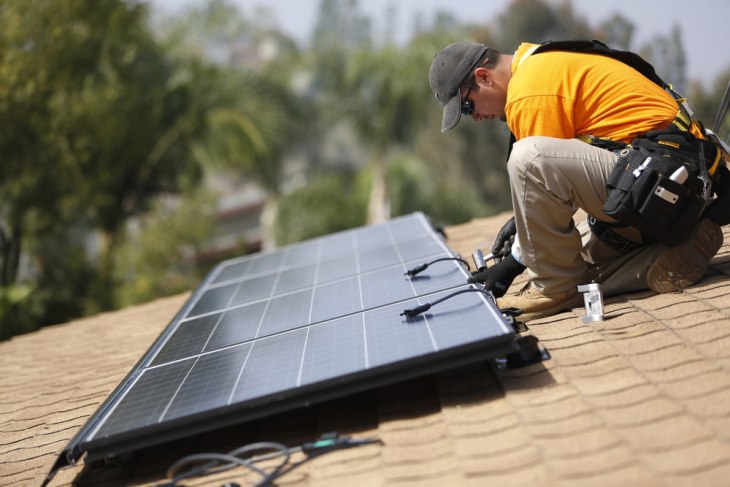
Power play: Utilities want solar users to pay up
See original article
Subscribe to:
Posts (Atom)