Monday, March 31, 2014

Friday, March 28, 2014
Solar “net metering” extended by California regulators
SF GATE. Posted on Thursday, March 27 at 7:01am | By David R. Baker If you’re a California resident who owns rooftop solar panels, you’ll want to pay close attention to a vote happening this morning in San Francisco. The California Public Utilities Commission is scheduled to vote on extending the rules that compensate solar homeowners and businesses for the excess electricity that they feed onto the grid. The system is called “net energy metering,” and it’s one of the main ways that California has encouraged the growth of the state’s solar industry. It’s also been the source of major friction between solar companies and California’s big electric utilities, who argue that net metering customers aren’t paying their fair share to maintain the grid. So a California law approved last year ordered the utilities commission to come up with a replacement system by the end of 2015. That same law also told the commission to create a transition period for people who already have rooftop arrays. After all, those people were counting on the compensation they’d receive from net metering when they decided to go solar. The compensation, which appears as a credit on utility bills, lets many homeowners slash their monthly utility payments close to zero.
See Original Article
See Original Article
Thursday, March 27, 2014
Why is solar power so expensive in America?

Meanwhile, the cost of solar power in the U.S., though it has fallen off a cliff since the late 1970s, remains relatively high. So what gives? Why can't we have cheap, clean solar power, too? A big part of it has to do with demand. In 2011, Germany boasted more than 21 times the solar power, per capita, of the U.S, which helped to drive down the price. And given that imbalance, American companies had a comparatively tougher task recruiting customers, so they spent 10 times as much as their foreign counterparts did on marketing costs.
But the biggest factors keeping American solar from catching up are so-called "soft costs," which include everything from fees and taxes to company overhead. For instance, while German installers added $1.20 per watt to the cost of each panel in 2011, American companies added $4.36 per watt. And according to the Department of Energy, soft costs make up 64 percent of the price tag on installing residential solar systems in the U.S.See original article
Tuesday, March 25, 2014
Commercial Solar Grid Parity Now Reality In Italy, Germany, & Spain
CLEANTECHICA. By Zachary Shahan. The days when solar power was more expensive than other power sources are quickly passing us by. News out of Europe is that commercial solar power is now at grid parity in some major European countries. A new study, the PV Grid Parity Monitor, conducted by consulting firm Eclareon, has found that commercial solar power hit grid parity in Italy, Germany, and Spain in 2013. Based on levelized cost of energy (LCOE) calculations, commercial solar now competes with retail electricity in these European countries. “In countries such as Italy and Germany, both at grid parity and with proper regulation, PV systems for self-consumption represent a viable, cost-effective, and sustainable power generation alternative,” said David Pérez, partner at Eclareon in charge of the study.
See original article
See original article
Thursday, March 20, 2014
New Solar Hot Water Incentives for Low-Income Residences in California!
California Solar Initiative- CSI-Thermal Program Low-Income Program. Incentives are now available for Solar Water-Heating Systems for Low-Income Single and Multifamily Residences!
The CSI-Thermal Low-Income Program provides rebates to utility customers who install solar water heating (SWH) systems that displace natural gas usage. On October 6, 2011, the CPUC approved a Decision creating the CSI-Thermal Low-Income Program, which allocates $25 million to promote the installation of solar water heating (SWH) systems on qualifying low-income single-family and multifamily residences through a program of direct financial incentives. Incentives are available to customers who currently heat their water with natural gas in the service territories of Pacific Gas and Electric Company (PG&E), San Diego Gas & Electric (SDG&E), and Southern California Gas Company (SoCalGas).
Single-family SWH systems that displace natural gas can qualify for incentives up to $3,750. Multifamily applicants can qualify for incentives up to $500,000. Actual incentive amounts will be based on the expected performance of the system as predicted by the SRCC rating and positioning, as is current practice in the CSI-Thermal General Market program. Single-family low-income SWH systems will be determined using the existing CSI-Thermal single-family calculator, and multifamily low-income SWH system will use the CSI-Thermal multifamily calculator. Incentive levels will decline in four steps as the program meets certain installation benchmarks.
See original article
The CSI-Thermal Low-Income Program provides rebates to utility customers who install solar water heating (SWH) systems that displace natural gas usage. On October 6, 2011, the CPUC approved a Decision creating the CSI-Thermal Low-Income Program, which allocates $25 million to promote the installation of solar water heating (SWH) systems on qualifying low-income single-family and multifamily residences through a program of direct financial incentives. Incentives are available to customers who currently heat their water with natural gas in the service territories of Pacific Gas and Electric Company (PG&E), San Diego Gas & Electric (SDG&E), and Southern California Gas Company (SoCalGas).
Single-family SWH systems that displace natural gas can qualify for incentives up to $3,750. Multifamily applicants can qualify for incentives up to $500,000. Actual incentive amounts will be based on the expected performance of the system as predicted by the SRCC rating and positioning, as is current practice in the CSI-Thermal General Market program. Single-family low-income SWH systems will be determined using the existing CSI-Thermal single-family calculator, and multifamily low-income SWH system will use the CSI-Thermal multifamily calculator. Incentive levels will decline in four steps as the program meets certain installation benchmarks.
See original article
Tuesday, March 18, 2014
L.A. Can Lead the Way with Solar Rooftops
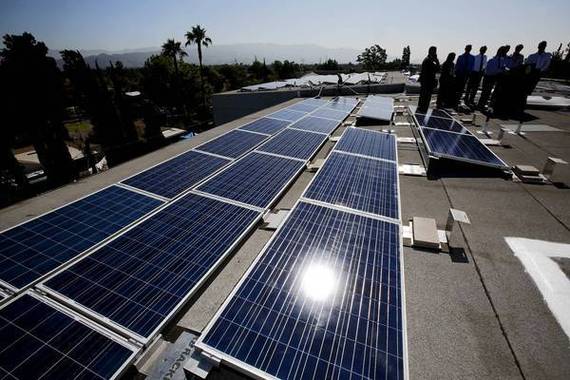
In contrast to the public's dismay with oil drilling, an overwhelming majority of L.A. voters have steadfastly demanded that local solar power more of their city. City council members -- as well as a broad coalition of business, civic, academic and environmental groups -- have echoed the public's call. To address this demand the DWP launched its CLEAN L.A. Solar program last year. Through this program, the utility pays customers for solar energy generated on rooftops throughout the city. CLEAN L.A Solar is on pace to bring 150 megawatts of local solar online by 2016 -- enough to power more than 32,000 homes. In addition to significantly reducing carbon emissions, CLEAN L.A. Solar also translates demand for clean energy into local economic growth. The program will create 4,500 jobs and generate $500 million in economic activity according to the Los Angeles Business Council.
See original article
Monday, March 17, 2014
Solar Power Threatening Future for U.S. Electric Utilities
OILPRICE.COM March 17, 2014. By Llewellyn King. The unlikely disruptive technology that is causing the trouble is rooftop solar power. Back in the energy turbulent 1970s, solar was a gleam in the eye of environmentalists who dared to dream of renewable energy. It looked like a pipe dream. Very simple solar had been deployed to heat water in desert homes since indoor plumbing became the norm. Making electricity from the sun was many orders of magnitude more complex and it was, anyway, too expensive. The technology of photovoltaic cells, which make electricity directly from the sun, needed work; it needed research, and it needed mass manufacturing. Hundreds of millions of dollars later in research and subsidies, the cost of solar cells has fallen and continues to go down.
Today, solar certainly is not a pipe dream: It is looking like a mature industry. It is also a big employer in the installation industry. It is a player, a force in the market. But solar has created a crisis for the utilities. In order to incubate solar, and to satisfy solar advocates, Congress said that these “qualifying facilities” should be able not only to generate electricity for homes when the sun is shining, but also to sell back the excess to the local utility. This is called “net metering” and it is at the center of the crisis today -- particularly across the Southwest, where solar installations have multiplied and are being added at a feverish rate. Doyle Beneby, CEO of San Antonio, Texas-based CPS Energy, the largest municipal electric and gas utility in the nation, said, “The homes that are installing solar quickly are the more affluent ones.” The problem here, he explained, is that the utility has to maintain the entire infrastructure of wires and poles and buy back electricity generated by solar in these homes at the highest prevailing rate -- often more than power could be bought on the market or generated by the utility.
Steve Mitnik, a utility industry consultant, said that 47 percent of the nation's electric market is residential and the larger, affluent homes -- which use a lot of electricity, and generally pay more as consumption rises -- are a critically important part of it. Yet these are the ones that are turning to solar generation, and expect to make a profit selling excess production to the grid.
But who pays for the grid? According to CPS Energy's Beneby, and others in the industry, the burden of keeping the system up and running then falls on those who can least afford it. The self-generating homes still need the grid not only to sell back to but,more importantly, to buy from when the sun isn't shining and at night. For some in the utility industry, net-metering is just the beginning of a series of emerging problems, including:
- Big investments are needed in physical security after the sniper attack last October at PG&E Corp.'s Metcalf transmission substation, which took out 17 huge transformers that provide power to California's Silicon Valley.
- New investment is needed in cybersecurity.
- Improved response to bad weather is a critical issue, especially in some Mid-Atlantic states.
Beneby believes the solar incursion into the traditional marketplace might be the beginning of more self-generation -- such as home-based, micro-gas turbines -- and utilities will and must adjust. He is something of a futurist and points out that in telephones, once a purely utility service, disruption has been hugely creative. Environmentalists are as disturbed as the utilities. Some are calling the imposition of a surcharge on rooftop generators, as in Arizona recently, an attempt by the greedy utilities to stamp out competition. But many are seeking alternative solutions without a war over generating, and without punishing those unable to afford their own generation.
See original article
Today, solar certainly is not a pipe dream: It is looking like a mature industry. It is also a big employer in the installation industry. It is a player, a force in the market. But solar has created a crisis for the utilities. In order to incubate solar, and to satisfy solar advocates, Congress said that these “qualifying facilities” should be able not only to generate electricity for homes when the sun is shining, but also to sell back the excess to the local utility. This is called “net metering” and it is at the center of the crisis today -- particularly across the Southwest, where solar installations have multiplied and are being added at a feverish rate. Doyle Beneby, CEO of San Antonio, Texas-based CPS Energy, the largest municipal electric and gas utility in the nation, said, “The homes that are installing solar quickly are the more affluent ones.” The problem here, he explained, is that the utility has to maintain the entire infrastructure of wires and poles and buy back electricity generated by solar in these homes at the highest prevailing rate -- often more than power could be bought on the market or generated by the utility.
Steve Mitnik, a utility industry consultant, said that 47 percent of the nation's electric market is residential and the larger, affluent homes -- which use a lot of electricity, and generally pay more as consumption rises -- are a critically important part of it. Yet these are the ones that are turning to solar generation, and expect to make a profit selling excess production to the grid.
But who pays for the grid? According to CPS Energy's Beneby, and others in the industry, the burden of keeping the system up and running then falls on those who can least afford it. The self-generating homes still need the grid not only to sell back to but,more importantly, to buy from when the sun isn't shining and at night. For some in the utility industry, net-metering is just the beginning of a series of emerging problems, including:
- Big investments are needed in physical security after the sniper attack last October at PG&E Corp.'s Metcalf transmission substation, which took out 17 huge transformers that provide power to California's Silicon Valley.
- New investment is needed in cybersecurity.
- Improved response to bad weather is a critical issue, especially in some Mid-Atlantic states.
Beneby believes the solar incursion into the traditional marketplace might be the beginning of more self-generation -- such as home-based, micro-gas turbines -- and utilities will and must adjust. He is something of a futurist and points out that in telephones, once a purely utility service, disruption has been hugely creative. Environmentalists are as disturbed as the utilities. Some are calling the imposition of a surcharge on rooftop generators, as in Arizona recently, an attempt by the greedy utilities to stamp out competition. But many are seeking alternative solutions without a war over generating, and without punishing those unable to afford their own generation.
See original article
Subscribe to:
Posts (Atom)